
We are pleased to announce the publication of two new scientific articles that highlight the crucial role of school environments and nature‑based solutions in advancing more resilient, inclusive, and healthy cities.
Together, these studies provide robust evidence to support urban and educational policies that place wellbeing, equity, and climate adaptation at the core of city planning.
🌱 Greening schools for climate‑resilient, inclusive and liveable cities
Nature Climate Change (2026)
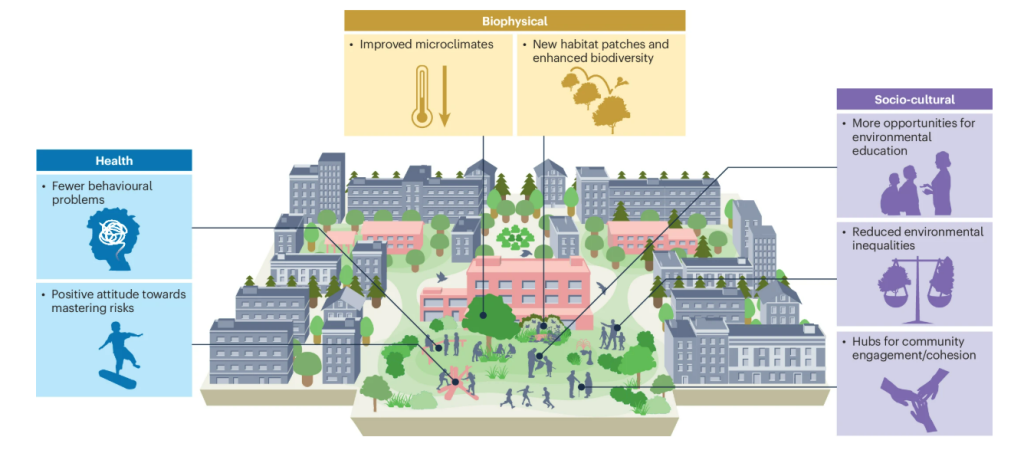
The first article, published in Nature Climate Change, explores the transformative potential of greening school environments as a multifunctional urban climate adaptation strategy.
The study shows that turning schoolyards into nature‑based climate shelters not only helps mitigate extreme heat, but also:
- improves children’s health and wellbeing,
- promotes equity and social inclusion,
- strengthens learning experiences and reconnection with nature,
- and generates benefits that extend beyond schools to the wider urban community.
The findings emphasise that schools can act as strategic urban nodes for climate‑resilient development, integrating social justice, quality education, and environmental sustainability.
👉 Read the full article:
https://www.nature.com/articles/s41558-025-02519-3
🌿 Towards equitable nature‑based outdoor activities in schools: Barriers, enablers and use patterns in Brussels
Urban Forestry & Urban Greening (2026)
The second article, published in Urban Forestry & Urban Greening, focuses on everyday use of green school spaces in Brussels, with particular attention to equity in access to nature‑based outdoor activities.
By analysing barriers, enabling factors, and patterns of use, the study reveals how social, institutional, and spatial conditions shape who can truly benefit from green school environments. The findings provide practical insights to:
- reduce inequalities in access to nature,
- better integrate outdoor activities into daily school routines,
- and design school spaces that are more inclusive and socially just.
This research offers key guidance for education and urban policies aiming to ensure that the benefits of nature reach all students, regardless of their socioeconomic background.
👉 Read the full article:
https://www.sciencedirect.com/science/article/pii/S1618866726001299
📣 A Shared Message
Together, these two publications reinforce a central message: schools are critical urban infrastructures for addressing today’s climate and social challenges. Integrating nature into educational spaces is not only an environmental intervention, but a powerful strategy to advance equity, health, and more resilient urban futures.
We will continue sharing research and reflections that connect science, practice, and public policy in support of a fair and sustainable urban transition.